Showing posts with label Tips for the Design Team-curious; advice; blog series; 'Design Teams';. Show all posts

Friday, 10 June 2011

Tips for the Design Team-curious. 8: What did I miss? Round-up.

Hello for the last time in the Tips for the Design Team-curious series.
Today I'm going to address some of the questions I've had from readers seeking more information on:
  • What to include in your Design Team application email;
  • How to approach a magazine with your work ... and
  • The challenge of setting up your first blog.
But first, let me just say ...

... while this  may be the end of the 8 specific posts I set aside to focus on the topic, the conversation's not over ... or at least I hope it isn't!

For a start, the conversation was recorded:
  • the posts themselves aren't going anywhere!
  • they'll be listed on their own page for easy access for the foreseeable future;
  • so even if you're not contemplating a DT role, or seeking publication or if you haven't set up your blog yet ... all the advice will still be there, ready and waiting ... when you are.
Plus, the conversation has been continuing in other formats, so a big THANK YOU to:
  • those who blogged about this series;
  • those who tweeted about it, retweeted and shared links;
  • those who emailed and were so open about your creative hopes and fears;
  • those who subscribed to my blog due to this series;
  • those brand new readers who left me some delightful comments ... and ...
  • those of you who already know me who joined in the conversation too. Seeing your familiar names in my comments really made me feel part of something bigger than and beyond my small blog corner.
And lastly ... the conversation will go on ... because you can't shut me up that easily ...
When I was small [yes, yes, I am still small now ... let me start that again ... ] When I was young, if had an idea for an activity or game or project I wanted to try out, I would often pester my family to join in with me.

I'd suggest to them things that 'we' could ... as opposed to just little old 'me'.

Part of me wanted to carry them along and sweep them up in my grand plans, convincing them of how good it would be if they joined in! I thought that if I was so excited about the task, they would be too and that everyone could share what I was feeling.

And things haven't much changed.
While I grew [somewhat] bigger ... I'm still here -  wanting to take people with me -  wanting to demonstrate that the things I can achieve they can achieve too ... basically I've been trying to show you that my game can be your game too!

And I'm not done yet ... so expect to find me tugging at your sleeve suggesting you can do it /here's how to do it and just general personal cheerleading from me in the future!

But let's return to now and to ...

Design Team application emails:
OK then, I suppose the first part is easier to answer than the last, so:
  • Unless the DT specifically states they want pictures in the body of the email [which I don't think I've ever seen] simply send your chosen images as attachments to the email application.
  • Lts of DTs don't even ask for images - only a link to your blog or gallery - which is why it's a good idea to keep them up-to-date when you're seeking a DT role.
As for the second part of the question - and what the recruiters want to hear about you ... well ... that's a lot trickier as every team is seeking something slightly different depending on their style, attitude and readership.

However, here's some great, general advice from my one-time Design Team-Mamma Gauche Alchemy's Amy Wing:
Here - as I covered in detail in Part 3 'Shaping Up for Selection' - is again why it's so important you apply to a team you actually WANT to be on ... rather than being on a team for the sake of it, just so you can put their blinkie on your blog!

This doesn't mean you always have to know an awful lot about the team in advance or admit to life-long undying admiration for everthing they've ever done. Clearly opportunities will arise withing teams you've never even heard of  [Gauche Alchemy were a brand new business when I applied ... but even then I knew I wanted to be part of it].

Here's how to get a feeling for a team and where to pick up ideas of what makes them tick:
  • read their 'about us' / mission statement etc on their website / blog;
  • read their blog posts;
  • read back through their tweets - you don't need to be signed up to Twitter to read things there;
  • look at the blogs of existing or previous DT members;
  • read their product descriptions in their shops and familiarise yourself with their product lines.
Expressing your enthusiasm for their brand/blog should come easy if:
  • you like or even love their product ranges;
  • the products are something you've always wanted to try out;
  • their blog inspires you;
  • you creative outlook feels complimentary to theirs.
Conveying a genuine interest and enthusiasm for a particular brand will be far easier, and less time consuming than trying to fake it while sounding genuine!

However, your application doesn't need to be totally focussed on how good they are, in fact ... you shouldn't go too far in that direction as Amy continues:
Go back to Part 3 'Shaping Up for Selection' for more advice on what to avoid and the kind of confidence you should try to convey.
But here are a few ideas to adapt for the About Yourself section:
  • Inject your own personality in here;
  • making yourself memorable;
  • give them a glimpse of the real person they'll be taking on board - not just a project-making machine. They want this as much as you do!
Describe your creative style -
  • does your style fit theirs or are you offering them something brand new and fresh?
  • tell them why you will be good for them;
  • give examples of how their product suits your style;
  • surprise them with a unique use for a productof theirs;
  • eg. "My work is  best described as clean and simple / grungy / quirky / open / experimental / minimal with a hint of chaos"
  • eg. "Your images would make an amazing effect on my fingernails ..."
Describe your creative environment -
  • do your collections reflect what you'll be making for the team?;
  • is your creativity evident to a stranger from 100 paces on a foggy day?
  • eg. "Busy city girl by day - paper-layering, embellishment-making; vampire-scrapper by night"
  • eg. "If you're ever in the neighbourhood, just head for the house with the ribbon wreath on the door and pom-poms in the trees and you've found me" 
  • "My children have grown up believing it'sperfectly normal for your clothes to perfectly match the latest scrapbooking range".
Describe your experience or specialisms -
  • what are you great at?
  • what do people know you for?
  • can you write tutorials?
  • tell them how your photography compliments your projects?
  • do you blog often?
  • perhaps you've studied something useful to add in here - even classes you may have taguht previously;
  • eg. "a lifetime of experimenting with fabric / UTEE / acrylic paint"
  • eg. "I'm always seeking to find creative stamping techniques" etc
Describe your personal philosophy or suitability -
  •  are you chatty? - useful if they want someone using their message boards / Facebook etc
  • are you interested in others? - useful if they'll expect you to leave comments on their readers' challenge entries;
  • are you organised / used to working to deadlines / someone who likes to plan ahead? - tell them so.
  • highlight places wherever your personality and attitude matches what they are looking for.
Right then .. that's enough for you to be going on with nowI think! Really the main idea is to be yourself - but specifically you - so you become a 'real' person alongside your creative work.

Obviously you begin building your application  around the requirements and criteria which DTs set out for you ... but what about when your application is speculative?

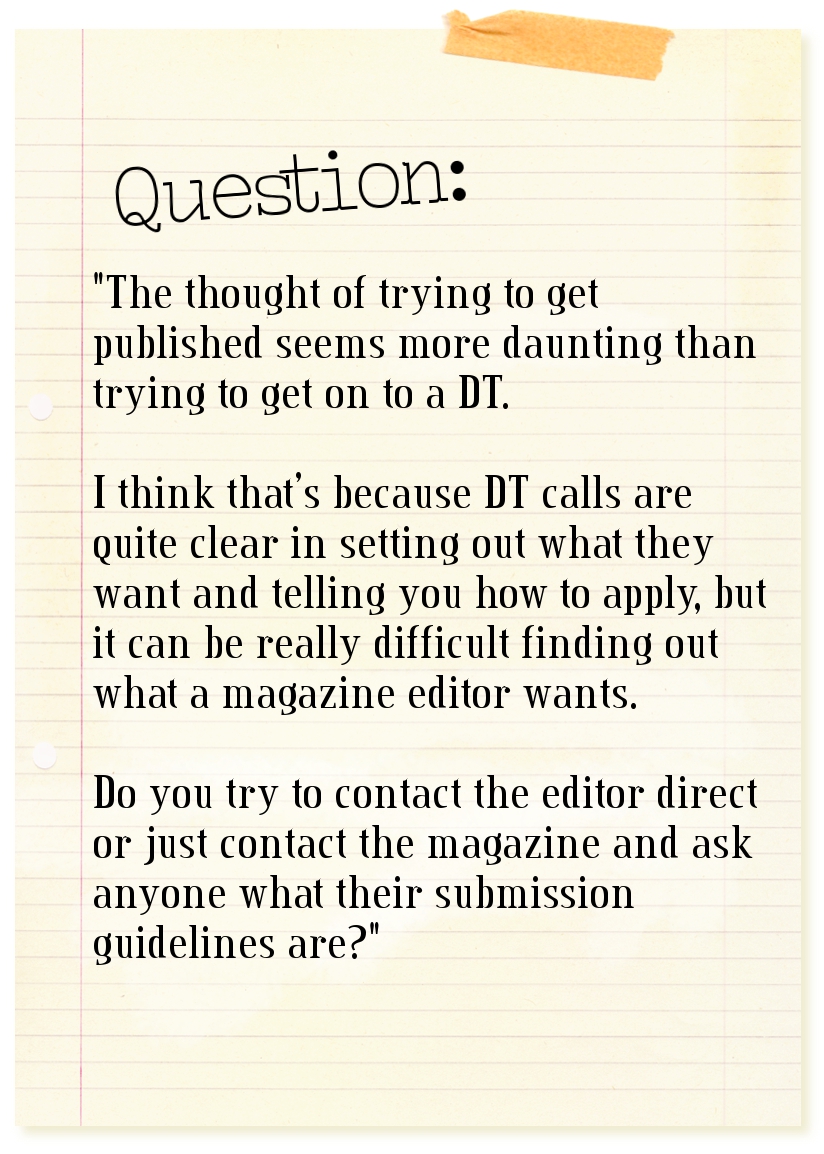
Here's another reader's question ....
How to approach a magazine with an expression of interest
Like a DT application, this too will begin with you doing your research.
  • is it a specific magazine you want to get into - or just publishing in general?
  • if it's a general desire to be in print, look around online and on the shelves of shops for the titles you want to approach;
  • look on their website for something like the heading 'Submission Guidelines';
  • eg. the Somerset titles have theirs set out very clearly - others have nothing;
  • if they don't have any specific submission details online but they have a generic company email - send a general letter to that, asking for the best way to make an approach;
  • similarly you could ask on Twitter - all the major craft titles have Twitter accounts run by someone in their PR department or their creative team who can point you in the right direction;
  • look in the front of their magazine 'in the flesh' for any contact details. 
If you found an editor's email address on their site, then to me that suggests they will expect someone at some point to contact them on it, so I wouldn't be afraid to do so.

The actual content of your email will also vary depending on what it is you're seeking to do. These can be put into two rough categories: general expressions of interest and specific proposals. [And even a mix of the two!]
1. To me, a general expression of interest would go along the lines of:
  • introducing myself;
  • stating I'd like to contribute to their magazine;
  • stating why I'd be appropriate for it ie: style of work, quality of work etc
  • providing links to my blog / Flickr gallery;
  • mentioning previous experience;
  • asking if it's better to approach them with a clear idea - or if I could just be considered for anywork they regularly commission.
2. If I was writing a specific proposal with a particular project in mind I would do the same as above except:
  • include clear details of the project / feature you'd like contribute;
  • include photos if you have any - perhaps of a similar project / technique you'd made before;
  • suggest where this might fit in their publication - pay attention to the existing content, regular features in the magazine.
Finally, don't worry if you don't hear back straight away, they're busy people and plan issues months in advance, there might not be room for you straight away.
And don't get disheartened of they don't take you up on your offer. Try again with a different idea or try another magazine.
Good luck - let me know how things turn out for you!

Finally, after receiving two emails containing almost the exact same question I want to quickly touch on the next point without letting myself get drawn into Tips for the Blogging-curious!!
A few notes on becoming a blogger
... and similarly:
 Firstly, it made me smile to read that people reading my advice admit to overthinking when I must be one of the world's biggest overthinkers ... as perhaps an 8 part feature on one topic might suggest!
That aside ... I'mthe fact that they've both taken time to write to me about it suggests to me that they're just looking for a small kickstart with something they really will attempt in the near future. 

Here's a few starting points for anyone who feels the same:


Before you begin:
  • You can start your blog without publishing it live on the internet straight away.
  • You can work on its design and content in draft / private mode until you feel comfortable releasing it into the world.
  • Most people I know began like this - it takes the pressure off you until you're ready.
Your content:
Don't think of your blog as a big empty space to fill - think of your life as a busy, eventful, creative, colourful event which easily has enough going on to spill over and get mopped up into blog posts! [Even if you don't think so yet!]
  • Personally I think 'blabbing' about what makes you happy is pretty much the perfect starting point!
  • If it makes you happy you're more likely to stick with it over time.
I used to blog only my craft projects as I really began to blog to get more DT chances! I would keep all my other little pieces of writing in my notebooks until eventually I decided that even if the bloggers I admired didn't blog things they'd overheard, or stories about their daily lives or what they'd found in junk shops ... it didn't mean I shouldn't. So I do. And I'm much happier!
  • I assure you that once you begin you soon forget about worrying about having something new to blog because you'll suddenly begin to see EVERYTHING as a blogging opportunity.
  • "Ooh I could blog about that" becomes a frequent phrase as it's all just what goes on in my daily life - elevated by being online for others to read.
  • Try setting yourself some categories [like the My Month in Numbers feature I blog, or any of the many many 'memes', lists, photo posts etc that groups of bloggers join in with eg. Julia Dunnit's What's on Your Work Desk Wednesdays [where you post a photo of what's on your workdesk ... on Wednesdays ... but you guessed that ... right?]
So categories are a great way to structure your blogging time and let your readers know the kind of things to expect from you. Don't give yourself too many strict days and rules though ... you'll be setting yourself up to fail. Do it as and when you feel like it! 
Spreading out the content:
Along with your categories helping with this, try:
  • keeping your posts focussed on one project / item at a time;
  • I see some people blogging lots of scrapbook pages/cards etc in a single post and not only do they not get the attention they deserve - they eat up content which could be spread out over a week.
  • more frequent posting will help you build a steady stream of readers ... who can also be future friends and industry connections.
As for wondering wondering whether anyone will read it ... well ....  you need to know in advance that it takes time and effort to gain and keep a readership.
If you enjoy what you're blogging about, then don't lose heart, keep having fun and gradually your network will grow.
Gaining readers:
Some great advice I once heardat work regarding marketing was that there's no point in creating amazing advertising posters ... if you only put them up in an empty basement! 
If no one can see it how will they know what you're selling? Same goes for blogging:
  • Are you on any crafting forums? Where allowed add a link to your signature in your profile etc;
  • Same goes for being on Twitter, Facebook, Flickr and any other social / community media out there;
  • If you're not on any other sites - don't panic, you can get yourself spotted by leaving comments on other people's blogs
  • People will see your name and often hop over to check out who left the comment;
  • Similarly,  joining in with challenge blogs gets people clicking through to your blog.
And know the following things now - in advance - so you don't go crazy thinking you're alone:
  •  ... sometimes you will hate blogging;
  • you will feel inferior to everyone who ever blogged. Ever.
  • you will compare yourself to people you actually really like ... and then resent their popularity;
  • you will think about giving it up and then ...
... one day:
  • you'll get a comment from someone and you'll smile ....or laugh out loud, or get goosebumps down your neck;
  • someone will compliment your work, someone will say 'well done'; someone will say 'thank you'.
  • And it'll be all you need to keep going ...  for at least one more post ... then another ...
If you need further tips on the technical sid eof blogging, there are endless classes out there you could take and lots of free resources if you just Google for 'blogging tips / how to / tutorials' etc

And, if you do start a blog after reading this - let me know and I'll post a link to your new online home in a post over here sometime. Then your first post will definitely have at least one reader in me ... and then anyone else who stops by here might just check you out too!
------------------------------------------------------------

Ok, that really is all for now! I'm all blogged out ... for today at least.
If you're currently testing out any of the tips from the series - or if you do so at any time in the future -  keep in touch . You can be the Tips for the Design Team-curious in-house design team trying out my 'product' for me!
Thank you again for reading the series, I hope you found something there which felt it was meant just  for you. Take it ... take it ... it's yours!

See you very soon.
Julie.

Friday, 3 June 2011

Tips for the Design Team-curious. 6: Making *it* work for *you*!

Hi, hi, hi.

We're on the home stretch now, just this plus 2 posts next week to go for my part of this series.

But for you ... I don't know, maybe this is just the start of something for you? I hope so! Even if it has nothing to do with Design Teams I wonder if the series has:
  • maybe marked a change in your confidence about your own work [see Part 3];
  • motivated you to develop your photography skills [as covered in Part 4]
  • or if you're looking for even more ideas of where to go and how to move forward in the industry without going down the DT route at all ... then hang around next week for Part 7 which will look at all kinds of new beginnings and new places to share your creativity.
But before that ... there's today ...

Today's post will be useful to you once you get that DT role or indeed if you're already on one:
Once you're on the team that spare time you once had to craft, create and experiment entirely for yourself will now, in part, have to be shared with your DT work and naturally creating and blogging to fit someone else's schedule comes with its own pressures. But with a few simple actions you can support both the team and the Brand of You at the same time.


Start managing your own 'brand'
If you focus on yourself, you can still doing offer the team your best work while making sure it's the best work for you too.  This is a great way to dodge feelings of resentment that could emerge while you're spending your free time promoting a company that isn't yours.


Manage your brand ... in your blog post layout:
  • Where possible, add your name at the top of your posts on the DT blog. Blogging platforms add the name of the author automatically at the bottom of the post but, let's face it, we don't always read down to the very end do we? Having your name at the top can help connect your name with the amazing project you made ... even if the reader clicks away before the end!
  • Similarly in my current DT role I put my first name in the title of my posts eg. 'Julie :: Vintage style card'. 
  • Add link to your blog at the end of the post [I make my name an active link to my blog] just in case your project leaves someone craving more of you!
Obviously different DTs might have different rules on this so you might want to check with them beforehand. But between them, the teams I've been on have encouraged their DT members to identify themselves at the start of a post to inject individual personality into the blog and also to end with their own unique sign-off for the same reason.

Manage your brand ... in your blog content:

Don't be shy to publicise the fact that you're on a DT on your own blog - this really doesn't mean your giving the hard-sell.
  • If you blog a DT project on your own blog make it clear that it's a DT project.
  • I like to do this as I don't want anyone to feel like I was 'selling' anything without being up front. 
  • Likewise, I prefer it when I read a someone elses blog, to see them mention it clearly in the post ... as opposed to leaving it out deliberately - or not stating it as they imagine everyone already knows what teams they're on. There are a lot of bloggers out there and with the best will in the world I can't remember everyone's details.
  • This needn't mean you make a major declaration of interest but just a simple 'Hi, here's my DT project for X this week' keeps things nice and open [or maybe it's just me who cares about this??]
  • Publicise your turn on the DT blog in the same way you would your own posts. Seeing as how many DTs expect you to use social networks anyway ... you might as well use it to your mutual advantage.
Also,
  • when possible write posts, on your own blog on the same day you have a post on the DT blog to cross promote your work. 
This may seem like double the effort, but it needn't always be:
  • if you make 3 cards in a session, blog 2 for the DT blog and put one on your own with links to/from both posts;
  • if you blog a layout on the DT blog, maybe blog an embellishmet or technique you used on your own blog;
  • if it's a stamped image you blog for the DT, show a few colour variations on your own ... anything to increas ethe chances of a reader hopping between them. More readers for your own blog + more for the DT blog too = win, win.
  • the two blogs are likely to have a different readerships, so you're not really just showing the same people the same thing twice. 
    The calendar is your friend
    Firstly all those DT commitments will need adding into your calendar ... but while you're there let the calendar work in your favour.

    It will depend on what kind of creating you do and the nature of the team you're on, but still, there are many ways you can use your DT life to get your daily life organised in advance. Before starting from scratch on a new DT project, consult your calendar, see what's coming up ... and then:
    • make cards which  for upcoming birthdays, anniversaries etc etc
    • make your cards with someone specific in mind. This will save you having to find time later to make them a handmade card outside of your DT commitments!
    • make gift tags etc ahead of time for special occasions;
    • layouts, mini-books can all fulfil your DT commitments AND be given as a gift;
    • Altered items, off-the-page items, decorated notebooks / frames / boxes ... the list is endless ... but all can be made and blogged for your DT schedule, then wrapped [in bags you've made in a previous DT project!] then given as teacher's gifts, thank yous, emergency 'oh no I forgot it was your birthday' gifts.
     Far from stealing away all of your spare time your DT commitments can actually become a great opportunity to set time aside to create special handmade cards and gifts.


     But hey ... with all this give, give, giving ... don't forget to ...

    Please yourself!
    Yes, when I was on the Gauche Alchemy DT I made a scrapbook page about one of the toilets at work.
    • I made it because I wanted to,  not because it was a 'theme of the week' on their blog or anything!
    • It made me smile [you might remember from Part 3 that I made a few other pages that made me smile when I was on that team too!] ... and what else was I going to do with a photo I took in a toilet?
    • I've tried to organise myself enough so that I when I had something I HAD to do ... it was also something I WANTED to do, and would have done anyway.
    In short:
    • I've practised combining my 'hobby crafter' self with my 'DT crafter' self to make sure they don't become separate.
    So, that's why I say you should make what you want to make.

    It may sound obvious to say, after all, once we leave school we don't often sit around making things we don't want to make! But ...

    ... but when those deadlines are looming you can naturally be tempted to just make something, anything, to fill that gap! But you might not want to do this too often because, in effect, you'll wasting your 'wages'!

    In Part 2 we put to bed the myth that you get 'free' stuff when you're on a DT because you pay for it in time and effort. But when you're using those products - your wages - on:
    • projects you like'
    • projects that feel like 'you';
    • projects you can even say you love;
    • projects you would have made anyway even if no one was expecting you to ...
     ... well, then you're getting some true value from them.

    Because anything else:
    • such as making something because you had to;
    • using up all your fee [products] on a project you don't really care about and will probably bin afterwards;
    • and only doing it to please the DT blog ... 
     ...  well, to me that's a bit like going out to work, getting paid in hard cash ... but then spending all the money on your boss just to keep them happy!

    You wouldn't do it in 'real' life, so why fall into that trap in your DT role? As long as you're producing quality work and showing commitment to your team I see no reason not to keep yourself happy too!

    But ... once you're all happily settled into your DT marriage ... it shouldn't  mean you should let your crafting muscles get flabby ... you should still put the effort in ...

    Please yourself - but push yourself too:
    Here I'm not really talking about craftyfolk who are on a DT for the camerarderie or purely as a casual hobby, I'm really aiming this at those who are:
    • hoping a spot on a DT is only the start of a career [in whatever form] within the creative industry;
    • hoping to build a larger blog-following [for whatever reason ie: to build your own business around]; 
    • or even those hoping it will bring them something ... without quite yet knowing what the something is!
    So, this part is for you if you want to:
    • capitalise on the platform / audience you've been given on a DT blog;
    • really test yourself / prove yourself /stretch yourself while you're there;
    • prevent yourself getting bored or stuck in a creative rut ...
    ... then use the motivation of having to produce work to a schedule to push you into:
    • pushing the limits of the products you get sent;
    • thinking of alternative uses for them - novelty is often a winner on DT blogs as, really, as there is a danger of projects which all use the same products becoming 'samey'.
    • test out ideas, experiment;
    • keep a notebook of future ideas to tackle;
    • develop all those half-ideas in the back of your mind;
    • don't be afraid of being you. Don't water yourself down because you're on a mainstream blog. Presumably they chose you because they liked your work as it was! Don't go changing ...  
    • improve your photography skills and start writing tutorials as we covered in Part 4.
    And finally, if you want people to know you beyond your Design Team tenure be different ...make yourself  memorable!

    This way, not only will it help you in carrying readers with you across to your own blog ... if you're anything like me, it'll stop you getting complacent and even bored!
    I'll admit that I do get easily bored, distracted, eager to move on to the next new thing ... so all those tips I've just laid out are truly all ones I've tried to live by myself.

    When I worked with Banana Frog stamps, alongside plenty of cards and layouts, I also tried out  making jewellery, a belt, wrapping paper and notebooks. I stamped on tea towels, T-shirts, shoes, pebbles and sea glass [all those projects can be found in my master-list of DT projects!]

    And I even once attempted to make a project out of stamping on my fingernails using Staz-On ... it didn't work ... but I've still not entirely given up on the idea!

    And looking back on the work I did there I'm pleased I pushed myself:
    • Now I have a body of work, a post-DT-portfolio, of projects I can be proud of.
    • I have projects I can confidently show to magazine editors;
    • I have samples which I could easily build a class around and if I ever wanted to teach them.
    I made things I would never have just sat at home and made 'just because', but the deadlines and the knowledge that I had a larger platform than my own blog to perform on pushed me to make the most of it. Both for the team .. and for myself.
    • plan ahead as much as possible;
    • fit DT projects around things you need to make [ie. gifts + cards] or that you want to make [ie. creating your own albums etc];
    • Don't be shy of being 'you' even when you're representing the DT;
    • Don't be shy of discussing your DT work on your own blog - it's too time consuming to split yourself into two separate crafty-people!
    • Push yourself to try new things - don't always play it safe;
    • you can work with the calendar too, planing posts around special occasions, themes etc- this can help if you're stuck for ideas of what to blog.
    • draft some posts ahead of time, not everything has to be made, photographed and blogged in the same week. 
    • If a project would compliment an upcoming occasion [ie: Halloween, Christmas, Summer etc] why not draft out the post and then save it up until the next one comes around. Then you'll be ahead of the game.
    • if you start to resent blogging - have a break - think about what you like being featured on blogs then come back refreshed and do that!
     
    • I'm almost certain that, if you went back and replaced wherever I've written 'Design Team role' with 'whatever your job title is' and the words 'DT blog' with 'wherever you work' , the tips would  apply to you too;
    • Find ways within the system to develop your own role, either simply to keep you happy while you're there ... or to help you develop skills so you can move on!
    -------------------------------------------------------
    OK then, I'll leave you alone now ... so you can polish and refine your plans to single-handedly take over the Craftiverse.

    Best of luck ... and do let me know how you get on!

    See you next week for the final 2 parts.

    Julie

    --------------------
    Please note: During the series I do NOT refer in a negative way to any teams or companies by name. I ask that, if you share experiences or opinions in a comment, you stick to this too. Thank you in advance … you can collect yourself an ‘I Play Nice’ sticker for your cardigan on your way out.  

    © Julie Kirk 2007-2011 The images used throughout the series feature the projects I've made and photographed as part of my Design Team commitments over the last 4 years. 

    Wednesday, 1 June 2011

    Tips for the Design Team-curious. 5: Finding out about DT opportunities

    Hi, hi, hi.
    If Parts 3 + 4 did their job in inspiring you to pick up the Design Team gauntlet then the next thing you're going to need to know where to find those vacancies ... so read on ...

    Uncovering the opportunities

    They are out there ... trust me ... you just need to know where to look, so let's drop by the most obvious place first:

    [1] Blogs:The majority of companies, stores, challenge sites and so on will make an announcement about searching for new Design Team members on their own blog before anything else. In fact, they'll probably even announce a 'teaser' about it a few days in advance of releasing the actual details.

    If you've spotted a DT call on a blog then you're already likely to be a fan of the brand etc and the work of their existing DT as you were tuning in to their blog in the first place. And all of this should stand you in good stead when it comes to working out if that team could be the right fit for you.
    However ...

    .... call me psychic if you will, but while I know you follow a lot of blogs ... I doubt that you follow them all.

    So you're going to miss out on the opportunities from within all those teams you've never even heard of.
    Which is where the Scrapbook Calls blog comes in so very useful!
    Scrapbook Calls is fantastic resource [I'm not affiliated to it in any way ... I just think it's really useful!].

    Manufacturers, publications, online stores, challenge blogs and more ... can all submit the details of their DT calls, online crops, challenges, contests and events which then appear on the Scrapbook Calls blog for all to see.

    It really is a one-stop-shop for you to be introduced to many new blogs and lots of new opportunities.
    Just a note: many of the calls are from sites within the USA and not all of them accept international entries to their DT. This isn't a majority by any means, but I just thought I'd mention it before you sprint over there full steam ahead.

    [2] Social Media:
    Increasingly any manufacturer / online store / challenge site who has a blog is also likely to be involved on Facebook or Twitter too. As soon as they're ready to announce their call ... chances are you'll see it there first.

    So if you're not already signed up to one or both of those sites ... you might want to give that some thought. 

    As with everything I've covered so far in this series - developing social media skills are not something I'm broadly advising everyone to do 'just because'. 

    However, if your specific aim is to get on a Design Team, especially the better known ones, as I covered in Part 2 'Balancing Expectations' many  recruiters now include the use of social media as one of their DT requirements.

    But don't panic, it's not as big a task as you might fear! As some of you may already know ... when it comes to Twitter ... I've got your back!
    Earlier this year I delivered 'Tips for the Twitter-curious' a class which talks you through the ins and outs of having and effectively using a Twitter account. 

    I know that it's worked for many people ... because they've tweeted me to tell me so! So, if you're still on the Twitter fence ... give my series a read ... and see where it leads you. 
    If you're already using Twitter:
    • Firstly, make sure you're following all of the manufacturers / stores / blogs who you'd be interesting in seeing a DT call from.
    Then ...

    Save your searches

    Use the 'Saved Searches' function on Twitter to help you find out about all the DT calls from teams you didn't know existed!
    • Enter some search words into the search box at the top;
    • Try things such as 'Design Team call' or 'DT call' then hit the search button.
    • Twitter will then return all the tweets it finds which mention those terms.
    Here you'll get to see any call from anyone right across Twitter! And your chances of finding a DT opportunity then expand even further.
    • Now click 'Save this Search'.
    • Next time you'll only need to go to the 'Searches' tab on your Home page and select 'Design Team Calls' from the list of searches you've saved.
    • Twitter will do all the seeking for you. 
    Similarly, if you're following me over there [I'm @notesonpaper] I often Retweet DT calls I discover, as do others involved in the industry.

    So it's definitely a good place to hang around if you're looking for up-to-the-minute DT opportunities.

    • Check out Scrapbook Calls, subscribe to their blog; I think they even have an email newsletter too.
    • If you don't use social media already ... consider it ... soon; 
    • Refer to online tutorials - like my Tips for the Twitter-curious class - to help you with your first steps;
    • If you're already using Twitter, use the Saved Searches function to assist you.
    • Even if you're not interested in the DT element of the Scrapbook Calls blog, it's still worth you having a look at the contests, crops and other events advertised on there.
    • Also - if you click to their Scrapcalls Challenge Blogs button you can see their extensive list of challenge blogs which you might want to work your way through.
    • Entering all those challenges should keep you out of mischief - and keep your blog filled with new projects for a while!
    • It's not only opportunites and vacancies related to the crafts industry which are advertised on Twitter - I've seen many, many job opportunites / expressions of interest / 'can anyone help out' type tweets on there.
    • If you're job hunting make sure to follow any local agencies, business leaders/groups/networks etc plus any establishments you'd ideally like to work for;
    • This way you'll not only be there when they mention a new opportunity - you can get to know what's important to them, what they're engaged in, who else they connect with too. All useful information to have when seeking that new position.
    --------------------

    Before I go I'd like to sneak in a quick mention for a Guest Designing spot I have throughout June. It's for  Crafty Templates and I've been working with their latest Quirky Kit, the first project from which I've  blogged about over there today:
    Click image to visit the full post.
    But you see ... the interesting thing is ... designing with the Quirky Kits was my first ever Design Team experience!  Leo [who owns Crafty Templates] had emailed me to ask if I'd design for her kits after seeing my scrapbook papges in the UKScrappers gallery. I accepted and went on to design for her for 2 years.

    I remember being speechless when I read that first message; amazed that someone liked what I did enough to ask me to help promote her new kits. Now, almost 3 years to the day, here we are again ...
    • Leo emailed to ask if I'd like to be a Guest Designer for a month;
    • I accept and then realise what else I'm doing that month ...
    • Why, I'm slap-bang in the middle of delivering a series in which I get to pass on to you everything I learned from that first DT experience onward!
    A nice, entirely coincidental, but truly full-circle piece of timing ... wouldn't you say?

    Julie x
    p.s: see you soon for Part 6 'Making it work for you' where we'll look at surviving your DT experiences ... it is possible ... because look! I'm still here!
    --------------------
    Please note: During the series I do NOT refer in a negative way to any teams or companies by name. I ask that, if you share experiences or opinions in a comment, you stick to this too. Thank you in advance … you can collect yourself an ‘I Play Nice’ sticker for your cardigan on your way out.  

    © Julie Kirk 2007-2011 The images used throughout the series feature the projects I've made and photographed as part of my Design Team commitments over the last 4 years.

    Sunday, 29 May 2011

    Tips for the Design Team-curious. 4. Raising your creative game

    Hi again.

    Welcome to the half way point of 'Tips for the Design Team-curious' ... who knew I had 8 episodes worth of 'stuff' to say about life on a DT?

    [Well, I'd guessed as much ... but I didn't know for sure until I started!]

    Today's is another post aimed at a wider audience of creative bloggers, not just DT hopefuls, so do stick around. 

    Where Part 3 focussed on attitude and confidence I'm going to move on to some specific practical activities which could be useful for:
    • getting, keeping and making the most out of a place on a Design Teamand:
    • improving the appearance of your blog and boosting your readership.
    Either of these aims, as I've mentioned before, could be used as one of those external factors we seek to:
    • motivate ourselves into action;
    • give us permission to sit down and take time to create;
    • tackle something new;
    • develop a skill; and
    • shift our work to another level. 
    OK then, whether it's for your DT fitness; blog-improvement; or self-improvement here's your first tip ... use it how you will:
    Click image to visit original tutorial on making paper cameras.
    So:
    • you've put your time and effort into finishing a creative project which would make a great blog post or DT submission.
    • You want to share it online and to di this ...
    • Taking a great photograph is the best way to do it justice.
    Now, I'm no photography expert ... so before I pass on a few of my own amateur tips let me point you towards a fabulous series of [free] tutorials I came across just in time to share with you here:
    Click to visit Lisa's photography series.
    Lisa Spangler is delivering her 'Card Photography Series' via her blog Sideoats + Scribbles and so far it's been full of great, practical advice for taking better photos of your projects.

    And, should you need any further convincing to try it out then how about I tell you that Lisa works for Hero Arts and took the cover photo for their latest catalogue ... so ... yeah ... she might just know what she's talking about!

    As for me I really don't use my camera to its full potential. I still use the auto settings [maybe when I've finished following Lisa's advice I'll know better!] and I have negligible knowledge of lenses.

    In short, I know next to nothing ... and despite that, I know I can take a half-decent photo of my work!

    Here's how ...

    My tips:

    1. Use a tripod!  If you haven't bought one yet - you should!
    • They're not as expensive as you might fear.
    I have two: a regular adjustable one and a smaller flexible type, both of which I found in Aldi of all places which set me back less than £20 for the 2.

    I've had a quick look around online and I've found quite a few in places like Amazon and Argos for £20 and under. It seems a small price to pay for instantly better photos when compared to the price of a new camera!
    • Not only does the tripod cut out the blurriness caused by wobbly hands;
    • it leaves your hands free to move the object into better light, or at a better angle.
    • It allows you to easily stand back and tweak the scene your photographing ... which is actually my next tip.
    2. Photograph your work as if it's going to be in print.
    One of the most enduring pieces of advice anyone ever gave me about being successful in a job interview was:

    "don't wear a coat or jacket when you go in to the interview room."

    Bear with me on this ... it is relevant ... ish ...

    You see, apparently, without your jacket on, you look - to the subconscious  mind of your interviewers - as if you're already a part of their office

    Like you belong there.

    I think that's genius! [And yes, I have followed the advice. Even when I was cold. And I'm always cold.]

    So ... getting back to crafting ... :
    • if you treat your work with respect ...
    • if you photograph it lovingly and professionally ...
    • if you present it as if it's already headed for publication ...
    ... then maybe whoever you share it with will receive it in the same manner.
    This could:
    • make it easy for an editor to accept that your work already belongs in print;
    • make a DT recruiter imagine your work making their blog look great;
    • make it more likely someone surfing for inspiration will subscribe to your blog and become a regular visitor'
    • make your photo more likely to be pinned to someone's Pinterest boards, which, in turn drives traffic to your blog.
    A few ways to achieve a more magazine-styled shot:
    • Create a scene in your photos.   
    • Dress the 'set' with items which match the theme of your project;
      Click image to go to original post - Guest DT role for LittleMusings.net
    • add a backdrop which compliments the colours or patterns you've used.
    Obviously this isn't always necessary, but it does add a professional edge to your work ... and it's fun
    Plus if you're anything like me and you spend more time looking at your work on a screen [arranging, organising, uploading, blogging and linking to it etc] than you do looking at it in real life ... then a nicely composed, well lit photo of it is going to be so much nicer to look at for you too.

    And you'll be so much more proud to share it when you need to. 

    Once you've taken those photos ... if you don't manage to get it perfect everytime [who does?] you're going to want to ...

    Master a few simple photo-editing techniques.
    But by this I DO NOT mean you have to learn full-on packages like Photoshop.
    Does your computer software have in-built default photo-editing package? Mine has 'Microsoft Office Picture Manager' which serves me very well.

    If you don't have anything like this you can download either of these for FREE:
    • Picasa [very straightforward, easy to use, some nice additional features]
    • and GIMP [more complicated, but useful, like a 'lite' version of Photoshop. It's what I used to create all the images for this series.]
    I'm not going to take up space here giving you tutorials on how to use these as there are many existing tutorials online already for you to Google.

    [However, I don't rule out one-off tutorials on anything you're especially interested in. Just give me a shout if there's something you really want to know how to do.]

    But, if you learn nothing else I strongly suggest you conquer:
    1. adjusting the 'contrast' levels in your photo: playing around with things labelled 'contrast' / 'shadows' / 'midtones' or 'brightness' can all instantly transform a dull photo into a brighter, clearly defined scene.
    2. 'cropping' your images: this allows you to eliminate any messy backgrounds and to focus in on the actual project.
    OK then, now you've got great photos under your belt ... here's an idea for how to use them ...

    Develop tutorial-writing skills:
    Crafters are seemingly on a neverending quest for developing their crafty skills; collecting new techniques and having the mysteries of a new craft revealed to them and therefore nice, clear tutorials are a big draw.

    And if it's blog hits you're after, they're definitely a way to go and DTs know this too ...

    More and more they're making it a pre-requisite that you create tutorials during your time with them. So it really makes sense for you to practice this skill ahead of time on your own blog. 
    Then, when the right call for you arises, you can simply add links to your existing tutorial examples within your DT application. Win!

    I hadn't written any crafting tutorials until I began my DT role at Banana Frog but after two years of regular step-by-step posts and full-blown tutorials, by the time I began writing full features for craft magazines, including written instructions, I was more than ready for it.  
    Maybe the fact that I've written the series you're reading, plus the Twitter version before it, gives you an inkling that I really enjoy pulling ideas, photos and tips together for a instructional posts ... but, if you're wondering where to begin:
    • You can read through previous tutorials by browsing through my Design Team Projects page [feel free to take inspiration from their structure .. but please don't 'borrow' the whole project ...];
    • Don't panic if you don't generally enjoy writing: Instructional writing is a lot shorter, less 'fancy' and much more about recording information than being flowery with language!
    • Take step-by-step photos of your work in progress, then simply look at the photo and write out what's happening in it. You really don't have to say much more than what you can see.
    • Imagine you're just explaining to friend how you made something.
    But, if you're still not happy writing things down ... then maybe speaking's more your thing ...
    How do you feel about making video tutorials?
    Fast becoming a regular request in DT calls, the ability to create a video tutorial is something which, once again can give your DT application the edge over someone else and also increase traffic to your own blog.

    I'd love to have the right equipment or guts to give this a go myself ... but .. well I just plain have neither[I'm someone who can't even pluck up the courage to Skype!]. But, be rest assured, the minute I do ... you'll be the very first to know/see/hear my tiny voice with its North Eastern vowels.
    In contrast, if you want to pick up tips by watching someone who does know her way around a video tutorial, swing by Shimelle Laine's site.

    Shimelle's videos always make me feel like making something, which surely means they're doing their job?

    Whenever I watch them, it's a bit like how flicking through recipe books always makes me hungry ... even if I don't go on to make anything ... it's still given my appetite a prod!  

    --------------------------------------
    OK, I'll leave you alone now to go back and think about raising your creative game to a level YOU'RE happy with. All the advice is there for you to pick + mix from.

    [Pick + Mix? Mmmm ... I may just have prodded that appetite again ...]

    •  Don't wait for a DT call to kickstart you into presenting your work professionally - do it now!
    • Work on your photography skills.
    • Try writing tutorials.
    • Assume the confidence and actions of someone who's already in the role you want.
    • Great photos make for great blog posts. Sometimes you don't need words. Photography skills are a vital part of improving the look of your blog.
    • Write tutorials. About whatever it is you're good at. [Within reason ... ] :-O 
    • Take up your blogging space proudly.
    • Fill it with fabulous content even if at first only your friends and cat read it.
    • Great content [a bit like water] finds its own level and the right readers, who'll apppreciate you and your blog, will find their way to it eventually.
    • If you've got a job interview anytime soon .... and you give the 'no jacket' thing a go,  [unless there's a strict dress-code! Obvs.] then do let me know how it goes!
    • Whatever it is you want to happen, act like you have it now.
    • Don't wait to be handed the permission, the confidence, the skills to get where you want to be. Chances are  you'll wait a long time.
    • Set off in the right direction now, on your own. Then watch the world try to catch up with you!
    Finally ...
    • Does the whole notion of 'raising your game' actually scare a part of you?
    • Are you afraid of hearing 'who does she think she is?' from others ... or even your own inner critic?
    If so then this is a good time for you to fetch a pencil to write down a quote I stumbled across a few years ago [from Marianne Williamson]. Because, really, it's the only question you need to ask ... and answer:
    • "We ask ourselves, 'Who am I to be brilliant, gorgeous, talented, fabulous?' Actually, who are you not to be?"
    And with that ... I'll leave you to begin your game-raising in peace.

    I'll see you soon for Part 5.

    Julie x
    --------------------
    Please note: During the series I do NOT refer in a negative way to any teams or companies by name. I ask that, if you share experiences or opinions in a comment, you stick to this too. Thank you in advance … you can collect yourself an ‘I Play Nice’ sticker for your cardigan on your way out. 

    © Julie Kirk 2007-2011 The images used throughout the series feature the projects I've made and photographed as part of my Design Team commitments over the last 4 years.
    Sticky tape digi-image from Pugly Pixel.

    Monday, 23 May 2011

    Tips for the Design Team-curious. 1: So you want to be on a Design Team?

    Hi and welcome to the first round of ‘Tips for the Design Team-curious’.

    If you’ve just landed here for the first time you might want to quickly read through the introductory post for a broader idea of the topics I’m going to be covering.

    But basically … I’ve kicked into shape everything I’ve experienced; reflected on; formed opinions of; read around and tweeted about regarding creative Design Teams over the last 4 years and condensed it into an 8 part series which I’ll be delivering to you across the next few weeks.

    Using this series to help you reach your Design Team goals:

    I think you should set aside a notebook/ journal/ scrap of paper specifically to jot down your responses to today's post and actually ... to the rest of the series.

    It might not surprise you to know that I find making notes on paper a useful method of clarifying your thoughts and it should help you identify your Design Team inklings and track how your expectations and motives change the more thought you put into the whole process.

    If nothing else … I'm giving you a legitimate reason to break open that a crisp new notebook you've been saving for a special occasion. [i know you have one!]

    Plus you could turn your journalling into an fascinating reflective scrapbook page
    when you do get on a DT!

    So, now I've set out my stall for you, you tell me …

    Who are YOU? For now, allow me to assume that you are indeed the DT-curious!

    You're the DT hopefuls, the creative-types out there who’ve never been on a Design Team but are now hearing that little voice daring you to branch out, take a risk, share with the wider world!


    If that's not you ... hang on, don't click away, at the end of the post, I’ll reinterpret my advice so it applies to you too!
    OK? OK.

    For anyone unfamiliar with the concept, let’s start from scratch …

    What is a Design Team? A ’Design Team’ / ‘DT’ is a group of people recruited by a manufacturer, retailer or challenge/inspiration blog to promote their products and services. Payment, if there is any, is usually in products which the DT members are expected to create with, photograph and blog about to spread the word. 

    In Part 2 [Wednesday 25th] I look what Design Teams expect of their members - I scrutinise those apects which a DT member or hopeful may [rightly?] feel are beyond their control. But today ...

    ...I'm focussing on YOU, and you should too ...

    Why might anyone want to be on a DT? And, more to the point ... Why do YOU? Without a doubt, being on a creative DT offers you opportunities beyond the end of your own blog’s back gate.

    So let’s start with what I believe are the 2 most discussed, but not necessarily the most rewarding, reasons people seek out a DT role: exposure and free products.

    1. You gain exposure to a new, wider, audience: So, you’re a blogger, you’ve built up a loyal following, you enjoy the interaction with your readers, you're proud of your creative work and you'd like more people
    to see it.

    Firstly - good for you! Being proud of your own talents is half the battle when applying for a post on a DT especially when there's a chance you won't be selected.

    It's vital to stay certain of your own creative worth so that if it's what you truly want, you can try again ... undeterred. 

    Secondly - I don't know if this is a peculiarly English/British trait but I think we should all be more open about wanting to be on a Design Team for, for want of a better word, the glory / the attention / the 'fame'. To show off.

    Of course you do. Why not be open about it?! There's really nothing wrong with being confident in the quality of your projects and wanting more people to see them. Being popular is alluring. No doubt about it. But ...

    ... do look carefully into your own reasons for wanting to get a place on a DT. Because if you really want this just to be popular and you get overlooked your confidence could be shaken.

    I'm not saying don't try out for a DT spot if you're not 100% confident in your work. Sometimes pushing yourself to take on new things can give you that boost toward becoming happier and more confident, with your output.

    A challenge such as applying for - and being successful in - a DT role can be the nudge you need to raise your own game. On your own terms.

    But I would advise is for you to be in a position where you already believe you're pretty great BEFORE you offer yourself up.

    Because if that's how you approach your application, even if you do get turned down you'll stand a good chance of believing in my Dad's advice [given when I've failed in job interviews etc] that the situation was 'their loss'.  Not yours.

    Then you can move on.

    2. You receive free products!!! And what's better than 'free'?:
    In the next installment of 'Tips for the Design Team-curious' I'm really going to explore this notion of DT members receiving 'free' product to work with ... but until then ... let's go along with the idea ...

    I'm not denying that it IS great getting products delivered to your door which you haven't had to pay hard cash for. It's fun. It's like a gift when it's delivered, it's exciting to open the box and see what you've been sent .. but ...

    But, we all know that in return you have to spend time blogging and promoting any projects you make with it. So, perhaps it's more useful to be interested into a DT not for the 'free' products [because they're not] but for ...


    3. You receive unexpected, interesting and challenging products!
    Now you're talking my language.

    Not having paid [in cash] for the products you'll be working with is one thing ... but not having chosen them is something else entirely. And the challenge those unexpected items present to your creativity is one of my favourite parts of DT life.


    As wonderful as all those supplies we've collected for ourselves are ... the sheer amount of them and 'baggage' they each contain can have a debilitating effect on our creativity.

    In contrast you have to use the contents of your DT package. You HAVE TO. And it's amazing how creative you can be when you have limits set on your supplies.

    Ironically, it's the limited supplies you have to work with in during your DT life which can actually offer you the most creative freedom.

    This 'free' stuff exists purely to be USED! You cannot save it, squirrel it away or 'save it for best'. Therefore the DT supplies can offer you freedom from the
     tyranny of your own stash!
    Similarly your productivity can increase if you're working to someone else's schedule ...
    4. It imposes order and discipline on your creativity!
    When you're part of a DT you agree to create and contribute work regularly and on time, a structure which you might not otherwise set for yourself. 

    Clearly this has pros and cons but for me personally ... I know I work better, quicker, with more purpose when there's a deadline to get me motivated: 
    While none of us should really need an external 'excuse' to ignore the ironing pile and pick up a craft knife ... I can't deny that having an obligation to make something for a DT has helped me justify my crafting time to myself from time to time ... and it might just work for you too!

    And finally ... for now ... you might want to join a Design Team as...

    5. You get to meet new people, broaden your network, make new links. I can only speak for myself here, but I've been fortunate to come out of DT life with some wonderful relationships under my belt.

    As creative people **sweeping generalisation alert** we're often not used to the camaraderie of group activities while growing up. We were often the ones chosen last when the sporty-types were picking the teams - [yes, I am speaking from personal experience!] - and being part of a team of arty, creative, make-y types can be a real treat.

    My time on the Banana Frog DT gave me something immediate and clear-cut in common with
    Hannah Milburn and Kirsty Neale both of whom I knew before we all ended up recruited to the same DT, but who I got to know so much better through that initial connection. The DT gave us something to talk about until we truly got to know one another and while none of us remain on the Banana Frog DT, we've remained close friends.

    Furthermore, you can get to know the people who run the Design Team.
    Having a close connection to someone in the industry who knows you're not only talented, but reliable too, can be of benefit to you in the long run if you're ambitious, forward-thinking, planning ahead for a future venture, branching out, developing your own creative industry ideas.

    While there are no guarantees it can't hurt your future chances of having them co-operate, give advice, work alongside you, accespt a proposition,  if you've been showing your best side throughout your DT term for them.
    -----------------------------------

    OK, that's enough thinking and making notes for you for now. Let's see if I can help clarify some of today's ideas:
    • Before you ask how to get on a DT, think about why you want to be on one. This should help you deal with your expectations of DT life.
    • Ask yourself if you most drawn toward: the camerarderie; the free stash; the discipline or the opportunities.
    • All are available to you to a greater of lesser extent, but again, working out what you'd be happy with now, will help manage your expectations and decision making in the future.
    • Make some notes on what it is you feel being on a DT could bring you and which aspects of your personality it would appeal to.
    • This will also help when it comes to identifying which kind of team you'd be happiest on [which I'll cover later in the series].
    • Have you ever asked yourself why you blog? [Ironically I started mine as Design Teams expect you to have one!].
    • Knowing why you blog can help you become more focussed in your content or your tone while posting.
    • Consider adding some of those motives to an 'About Me' page or in a text box in your sidebar. I have both. Go look! 
    • This can help clarify to your readers what they can expect from your blog and therefore why they should stick around post after post.
    • If you need discipline and deadlines to help motivate you, why not set yourself a regular blogging feature and get your readers to help hold you accountable for creatively and regularly 'showing up'?
    • You too can crack open a shiny new notebook ... in factI positively command you to! [That's just in case you needed an excuse!]
    • Analysing the motivations behind any of your goals is never a bad thing.
    • Being clear why you want what you want is not only useful in helping you achieve it ... it might actually reveal gaps in your thinking.
    • Is there another way you can achieve that feeling you're seeking ?
    • Is that thing you are focussing on [i.e getting on a DT] really just a distraction?
    • Sometimes this kind of thinking can lead you away from what you thought you wanted .. into something you really need!
    In a later post I'll be looking at precisely this point in relation to Design Teams where I'll be suggesting where else you can look to satisfy the kind of drives which are right now pushing some of you down the DT route.

    I'll be back on Wednesday with a no holds barred look at some Design Team expectations.


    But until then ...
    Until then I'll give you a chance to wade back through this post. I threw a lot at you so I'll give you time to go back and pick it all up.

    I'd love to hear your thoughts and comments so if you get time to leave me a message that would be great. Thank you.

    If, after reading this first post, you think it's worth passing on to friend, then please spread the word.
    And if you use Twitter you can give me your feedback and general reflections over there too. I'm @notesonpaper there. I'll be using the hashtag #dtcurious to discuss it. [And if you want to know more about that you might want to visit 'Tips for the Twitter-curious'  while you're here!]
    See you soon.
    Julie
    -----------------------
    Please note: During the series I will NOT be referring in a negative way to any teams or companies by name. I ask that, if you share experiences or opinions in a comment, you stick to this way of doing things too.

    Thank you in advance … you can collect yourself an ‘I Play Nice’ sticker for your cardigan on your way out.
    ;-)


    © Julie Kirk 2007-2011 The images used throughout the series feature the projects I've made and photographed as part of my Design Team commitments over the last 4 years.